
 Wildlife Tours
I was standing outside my tent at 5am in Kitenden Conservancy when our guide, Daniel, pointed at a shape moving through the mist near the swamp edge. He didn’t need binoculars. “That’s Craig,” he said, the way you’d recognize a neighbor’s walk from across the street. That is what tracking big tuskers in Amboseli actually feels like. Less luck, more local knowledge.
This big tusker elephants Amboseli guide covers what the profile-list sites skip: not just who these elephants are, but where a camp can actually put you to see one, and what your real odds look like depending on the season.
Big Tusker Elephants Amboseli Guide: What Counts as a Big Tusker
A big tusker is a bull elephant whose tusks each weigh at least 100 pounds (about 45kg). Some guides use the term “super tusker” for the same standard, though a few reserve it for tusks that nearly or fully touch the ground. Either way, this is genetics as much as age. A bull needs both the right bloodline and 35 to 50 years of undisturbed growth to reach that size.
Fewer than 30 confirmed big tuskers remain across the whole of Africa. Amboseli is home to more of them than any other single ecosystem, which is the entire reason photographers plan trips around this one park.
Why Amboseli Grew These Genes
Amboseli’s tuskers trace back to a small founder population that survived the ivory poaching crisis of the 1970s and 80s relatively intact, largely because of long-term protection by the Amboseli Trust for Elephants, active here since 1972. That continuity let the large-tusk gene keep passing down instead of getting shot out of the population, which is what happened in most of the rest of East Africa.
The park’s swamps also help. Amboseli’s permanent wetlands, fed by underground rivers off Mount Kilimanjaro, mean bulls don’t burn energy migrating long distances for water. More stable feeding means more energy for tusk growth.
Living Legends Worth Watching For
As of our latest camp reports, guides still regularly identify these bulls around Amboseli and the adjoining conservancies:
- Craig – Often called the last of the true super tuskers still alive, with tusks that nearly scrape the ground. He favors the Ol Tukai area and the swamp edges near Enkongo Narok.
- Tee Jay – A calmer bull often seen closer to the Amboseli-Kimana corridor, popular with photographers for how relaxed he is around vehicles.
- Vronsky – Named for a Tolstoy character, he ranges widely between the park and Kitenden Conservancy.
- Wikstrom, Michael, and Esau – Younger bulls still adding bulk, worth watching as the next generation of big tuskers.
Guides confirm identity by ear notches, tusk shape, and scarring, the same way rangers have logged individuals here since the 1970s.
The Ones We Lost
Amboseli’s tusker history carries real grief too. Tim, one of the most photographed bulls in the world, died of natural causes in 2020 at around 50 years old. Tolstoy, famous for a deep scar from a 2018 spearing that he survived, died of old age in late 2023. One Ton died in 2016 near Kimana. Further south in Tsavo, Satao was killed by poachers with a poisoned arrow in 2014, a loss that pushed conservation groups to fund more aerial patrols across the wider Tsavo-Amboseli corridor.
Each death is a reminder that these bulls are not renewable on a human timescale. A tusker that dies at 50 took half a century to grow into that name.
When and Where to Actually Look
Big tuskers roam huge home ranges, sometimes over 3,000 square kilometers between Amboseli, Kitenden Conservancy, and the Tsavo corridor. A two or three night stay is not a guarantee. Being honest about this matters more than promising a sighting.
That said, odds shift by season. In the dry months, from June through October and again in January and February, bulls concentrate around Amboseli’s permanent swamps: Enkongo Narok, Longinye, and the Olokenya Swamp. That’s when sighting odds run highest, often daily during a three-night stay near swamp routes. During the rains, from March through May and in November, elephants spread out across a much wider area, including into Kitenden Conservancy and toward the Tsavo corridor, and sightings become far less predictable.
Early morning, right after sunrise, is the best light and the best behavior window. Bulls feed calmly in open country before the day heats up and they retreat toward tree cover.
| Location | Distance from Amboseli gate | Best season for tuskers | Approx. daily fee |
|---|---|---|---|
| Amboseli National Park (swamp circuit) | Within park | Jun-Oct, Jan-Feb | USD 90/adult/day (KWS) |
| Kitenden Conservancy | Borders park, west side | Year-round, quieter | Bundled in camp rate, roughly USD 60-100/night |
| Kimana Sanctuary | 10km from Amboseli gate | Dry season | Approx. USD 25-52/adult/day (indicative) |
| Tsavo West (corridor access) | 70km, 1.5-2 hr drive | Historical range, less reliable | USD 80/adult/day (KWS) |
Getting Close, Safely
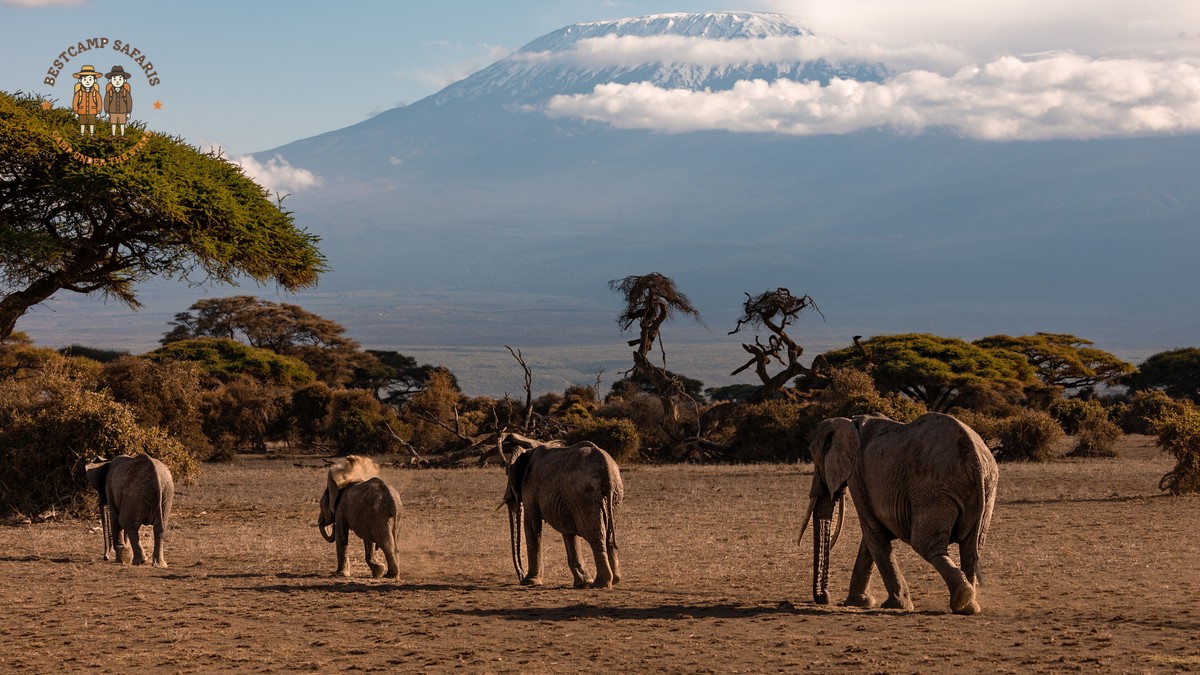
You cannot approach a big tusker on foot in Amboseli’s national park, and you shouldn’t want to. These are wild bulls in musth at times, and vehicles keep a respectful 20 to 30 meter distance as standard practice. What changes the experience is positioning, not proximity. A mobile camp set up near Enkongo Narok puts you on the swamp edge before the tour vans arrive from Nairobi and Ol Tukai’s larger lodges. That first hour of light, with the swamp mist still hanging low and Kilimanjaro turning pink behind the herd, is worth more than getting a few meters closer.
By mid-morning, the main swamp loop can get crowded with vehicles during July and August. Conservancy routes through Kitenden stay quieter, though tusker sightings there are less predictable since the bulls range further.
If you’re building a longer trip around this, our 5-day Masai Mara & Amboseli itinerary pairs peak swamp mornings with the Mara’s wider plains, and it’s worth reading our notes on the real odds of Big Five sightings alongside the Big Nine safari animals if tuskers are only part of your wildlife list.
The BestCamp Safaris Difference
We don’t promise a specific bull. Nobody honestly can, not even the trackers who know these elephants by name. What we do is build the itinerary around where the odds actually sit that week. Our guides radio between camps and share sightings across the swamp circuit each morning, so if Craig or Tee Jay was seen at first light near Longinye, your vehicle heads there before the swamp loop fills up. Camp placement matters too. We position mobile camps on the Kitenden side specifically so you’re moving toward the swamps at dawn instead of driving in from Ol Tukai after the light has already flattened out. It’s a smaller, quieter way to chase a sighting that most operators just hope for.
Plan Your Amboseli Trip
If watching one of Africa’s last big tuskers cross an open lakebed at sunrise is on your mind, let’s build a trip around it. Visit our contact page to start planning your Amboseli safari with BestCamp Safaris.


