
 Adventure Tours
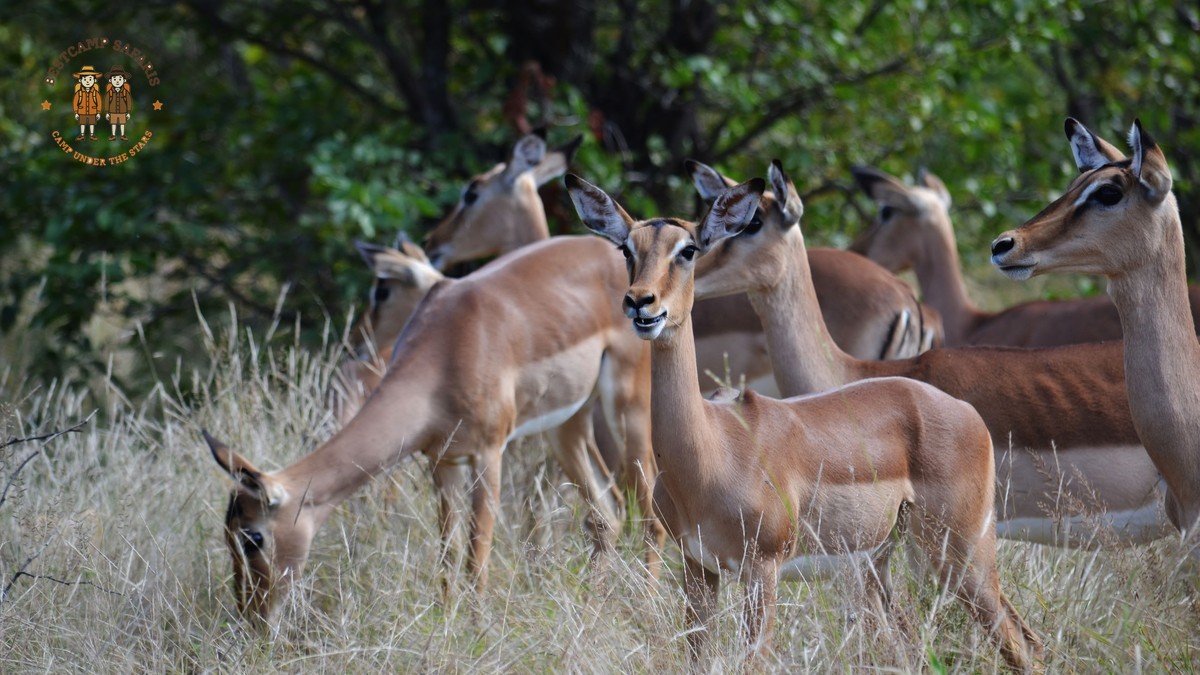
It is just after 5am and camp is already moving. Someone is folding canvas chairs by lamplight, the kettle is rattling on the fire, and your guide is doing a last check of the Land Cruiser before the gate at Talek opens. You climb in still half asleep, and within twenty minutes you are surrounded by tan-colored antelope grazing in every direction. Your guide says “impala” for one group and “Thomson’s gazelle” for the next, and you cannot tell what changed.
You are not alone. This impala vs gazelle identification Kenya guide exists for exactly that moment. Impala, Thomson’s gazelle, and Grant’s gazelle get mixed up constantly, even by travelers who have read every animal fact page before their trip. Those pages tend to stop at taxonomy. This one is built for the actual moment in the vehicle, with the light low and the herd moving, when you need an answer in five seconds.
Size and Build: The First Clue
Start with size, since it is the fastest read from a moving vehicle.
Impala stand about 75 to 92 cm at the shoulder and weigh 40 to 76 kg. They have a sleek, athletic build with long legs made for jumping, not just running.
Thomson’s gazelle, known locally as “Tommies,” are noticeably smaller. They stand around 55 to 70 cm at the shoulder and weigh just 15 to 25 kg, closer to the size of a large dog.
Grant’s gazelle sit in between in height but are built leaner, standing 75 to 90 cm at the shoulder and weighing 35 to 65 kg. Side by side with impala, Grant’s look narrower through the chest and a bit more delicate in the legs.
If you see a mixed herd, which happens often on the Mara plains, the size gap between the Tommies and everything else around them is usually the giveaway.
Horns: Who’s Wearing Them
This is the detail your guide will point to first, because it settles the sex question along with the species question.
Impala horns are the classic ridged, lyre-shaped horns you picture on antelope, and only males grow them. Female impala are hornless, so any impala without horns in a herd is either a female or a young male.
Both male and female Thomson’s and Grant’s gazelle grow horns, though females carry shorter, thinner, often slightly wavy horns compared to the males. Grant’s gazelle males in particular carry long horns, sometimes reaching 80 cm, that curve up and slightly back in a shape close to a lyre but noticeably straighter through the middle than an impala’s.
Quick rule: if you see a hornless individual grazing in a mixed herd, it is very likely a female impala, since female gazelles almost always have some horn growth.
Coat Color and the Marks That Give It Away
Color and pattern settle most remaining doubt.
Impala are reddish-brown on the back, fading to tan on the sides and white underneath, with a black stripe running down each thigh and a thin black line down the tail. Look for the “M” shaped black marking on the rump, visible when one bolts away from the vehicle.
Thomson’s gazelle are more sandy-tan with a bold black side stripe that runs the full length of the body from shoulder to hip, and a white rump patch edged in black. That side stripe is the single easiest mark to spot from a distance.
Grant’s gazelle are paler still, almost fawn-colored, and either lack a side stripe entirely or show only a faint one. Their white rump patch is larger than a Tommy’s and extends up onto the back, above the tail rather than stopping below it.
The black facial stripe running from eye to muzzle, present on both gazelle species, is thought to work with the body stripe to help herd members track each other’s movement at speed and possibly to break up the animal’s outline against low sun, similar to eye black on a football field.
Woodland Edge or Open Plain: Habitat Tells You a Lot
Habitat is a strong secondary clue once you have size and markings in mind.
Impala prefer woodland edges, riverine thickets, and areas with cover nearby. They rarely stray far from bush they can bolt into, which is part of why their jumping ability matters so much to them.
Thomson’s gazelle are creatures of the short-grass open plains, the kind of wide, treeless country you see through much of the central Mara. They rely on visibility and speed rather than cover.
Grant’s gazelle tolerate drier, more open country than either of the other two, including semi-arid bush near Amboseli and parts of Laikipia where rainfall is lower. They can go longer without drinking water, which lets them range further from rivers and waterholes.
Herd Behavior: Watch How They Move Together
Impala herds are usually female groups of 15 to 100 individuals guarded by one territorial male, plus separate bachelor herds of young males living apart. During the rut, roughly May through July in most of southern Kenya, you will hear impala males roaring and grunting to hold their harem, a sound many first-time guests do not expect from something the size of a large deer.
Thomson’s gazelle form loose, large herds that mix and split constantly, sometimes gathering in the thousands during the wildebeest migration months when they follow the same short grass.
Grant’s gazelle herds run smaller and more scattered, often in family groups of five to thirty, which fits their more spread-out, drier habitat.
Thomson’s Gazelle vs Grant’s Gazelle: The Real Puzzle
Once you can rule out impala, telling the two gazelles apart is where most guests still get stuck, since both are tan, both have horns on both sexes, and both are compact and quick.
The clearest test is the side stripe. Thomson’s gazelle have a thick, dark, unmistakable black band running the length of the body. Grant’s gazelle either have none or only a faint version.
The second test is the rump patch. On a Tommy, the white patch stays low and is capped by a black stripe. On a Grant’s, the white patch is bigger and runs up onto the back above the tail, uninterrupted.
Size helps too. If two similar-looking gazelles are standing near each other and one is visibly smaller and stockier, that is likely the Thomson’s.
Stotting: Why They Bounce Straight Up
You will see it within your first hour on a game drive. An antelope in the middle of grazing suddenly bounces straight up on stiff legs, all four feet leaving the ground at once, before running off normally.
That behavior is called stotting, or pronking, and impala, Thomson’s gazelle, and Grant’s gazelle all do it. Researchers believe it signals fitness to a predator, essentially telling a cheetah or wild dog “I have seen you and I can outrun you, so do not bother chasing.” It may also alert the rest of the herd that a predator is nearby.
Impala add a second move to their toolkit. When genuinely startled, a whole herd will explode in different directions with huge scattering leaps, sometimes clearing 3 meters in height and 9 meters in length, which confuses a predator trying to lock onto one target.
Impala vs Gazelle Identification Kenya: Where to Spot Each One
Different parks favor different species based on habitat, so where you are matters as much as what you are looking at.
| Location | Drive time from Nairobi | Approx. distance | Non-resident park/conservancy fee | Species most likely |
|---|---|---|---|---|
| Masai Mara National Reserve | 5 to 6 hrs by road (or approx. 45 min flight) | ~270 km | USD 100/adult/day (Jan-Jun), USD 200/adult/day (Jul-Dec) | Thomson’s gazelle, impala |
| Naboisho / Mara North Conservancy | 5 to 6 hrs by road | ~270 km | roughly USD 80-150/person/night, bundled into lodge rates | Impala, Thomson’s gazelle |
| Amboseli National Park | approx. 4 hrs by road | ~240 km | USD 90/adult/day | Grant’s gazelle, impala |
| Laikipia conservancies | approx. 4 to 5 hrs by road | ~200 km | indicative USD 70-100/person/night, bundled | Grant’s gazelle, impala |
The Mara’s open plains are where you will see the biggest mixed herds of Thomson’s gazelle and impala, especially along the Talek and Mara rivers. Our 5-Day Masai Mara & Amboseli itinerary covers both the grass plains and the drier Amboseli habitat in one trip, so you see both gazelle species and impala without doubling back to Nairobi.
For Grant’s gazelle specifically, drier country works better than lush riverine bush, which is exactly what you get on Laikipia conservancy game drives. Guides there tend to point out the rump patch difference early, since Grant’s and impala share the same scrubby terrain.
The BestCamp Safaris Difference
Any guidebook can list the markings. What makes the difference in the field is a guide who has watched the same herds for years and knows where the confusion actually happens, like a young male impala without full horns standing next to female Thomson’s gazelle, or backlit animals at 6pm when every coat looks the same shade of gold.
Our guides carry that kind of field knowledge, not a memorized script. On our 8-day mobile camping safari, you move between the Mara’s open grass and Laikipia’s drier bush, so you get to compare impala, Thomson’s, and Grant’s gazelle side by side across two different habitats in the same trip, rather than guessing from photos afterward.
Camp life backs that up too. Waking up to a bush breakfast being packed away, walking back into camp after dark by lamplight, hearing impala roar during the rutting season just outside canvas, all of it turns identification from a quiz into something you actually remember.
Ready to Tell Them Apart Yourself?
The fastest way to learn the difference between impala, Thomson’s gazelle, and Grant’s gazelle is standing in front of them with someone who can point out the stripe, the horns, and the rump patch in real time. Get in touch through our contact page and we will help you plan a Kenya safari built around the wildlife you actually want to see.


